Personal letters
How to write a personal letter that sounds like you
Choose one person, one real memory, and the thing you need to say. Use normal words. A letter does not need to sound impressive to matter.
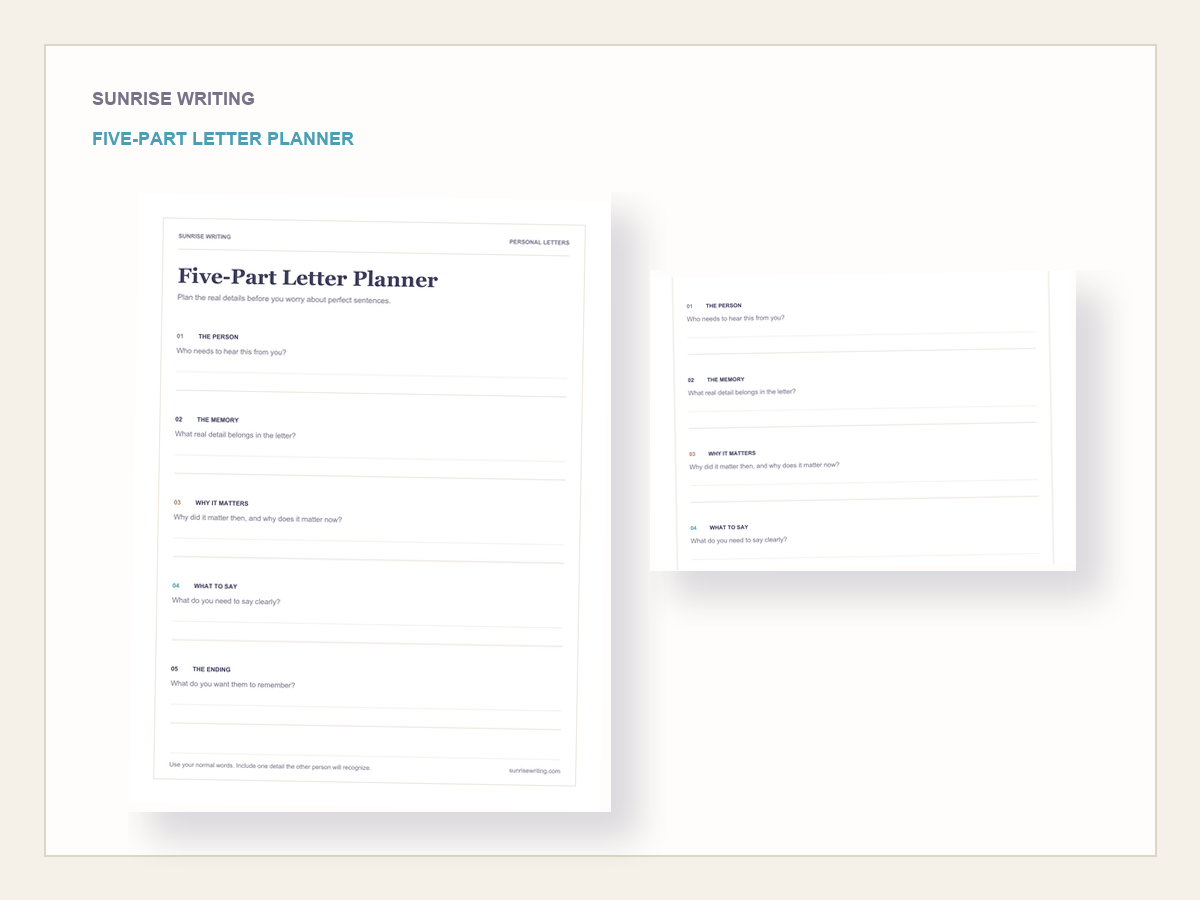
A personal letter sounds like you when it includes a detail the other person will recognize and says the main thing in words you would actually use.
Start with the person, not the opening line
Before you try to write “Dear…” decide who this letter is for and what you want it to do. Are you thanking someone? Apologizing? Saying goodbye? Telling them something you have never said clearly?
Write one private sentence at the top of your draft: “I want them to know…” Finish that sentence. You can remove it later, but it will keep the letter pointed at the real reason you are writing.
The five parts of a personal letter
You do not have to follow a strict format. These five parts simply give you a way through the page.
The person
Name who needs to hear this from you and why you chose them now.
The memory
Choose one moment you both know. Include a place, an action, or exact words they said.
Why it matters
Explain what that moment meant then and what you understand about it now.
What to say
Say the thank you, apology, truth, or wish directly. Do not make the reader guess.
The ending
End with the one thought you want them to carry after they put the letter down.
Use one detail they will recognize
General praise can be true, but it often sounds like it could belong to anyone. A real detail gives the letter a person, a place, and a moment.
General and polished
“Your unwavering support has been an invaluable source of strength.”
Plain and specific
“I still remember you driving across town when my car would not start.”
The second sentence does not explain everything. It does something better: it gives the reader a moment they can see. The next sentence can say why that moment mattered.
Example
I still remember you driving across town when my car would not start. You did not make me feel foolish for needing help. I have thought about that more times than you probably know.
This is a made-up example, not a story from a real person. It shows how one ordinary detail can carry the meaning.
For a thank-you letter
Name what the person did. Then explain what it changed for you. “Thank you for being there” becomes clearer when you add where they were, what they did, or what you were able to do because of them.
- What did they do that they may not realize you remember?
- When did their help matter most?
- What do you understand now that you did not understand then?
For an apology
Say what you did without hiding it inside a long explanation. Name the effect it had. Do not ask the other person to make you feel better, and do not turn “I am sorry” into “I am sorry you felt that way.”
A useful apology can be simple: what happened, why it was wrong, what you are sorry for, and what you will do differently. The other person gets to decide what happens next.
For a goodbye
You do not need to summarize a whole relationship. Choose one memory that shows what the person or place meant to you. Say what you will carry forward. If there is something you hope they remember, say it plainly.
Goodbye letters can be difficult to write. You can stop, return later, or keep the first version private. Writing the letter and sending it are two separate decisions.
Read it out loud once
When the draft is done, read it aloud. If a sentence feels unlike something you would ever say, make it simpler. Cut repeated explanations. Keep the names, places, actions, and exact words that make the letter yours.
Correct spelling and clear sentences help the reader, but polish is not the point. The part that matters is the part another person could not truthfully write for you.
Free printable
Plan the letter in five parts
The Five-Part Letter Planner gives you one page for the person, the memory, why it matters, what you need to say, and the ending.
Enter your email and we will send you the printable right away.